
Your Ads Are Optimising on Bad Data: A Practical Guide to Server-Side Tracking
Every bidding algorithm you use is only as good as the events it receives. Most accounts we audit are feeding theirs partial, duplicated or mislabelled data.
By Ads Ninza · Published 5 August 2026 · Updated 16 August 2026 · 9 min read
How to tell your data is broken in ten minutes
You do not need an audit to spot the symptoms. Check these.
- Platform totals versus reality. Add up conversions reported by Google Ads and Meta, then compare with orders or enquiries you actually received. A gap in either direction — reported higher or lower — means attribution and measurement need work.
- Event match quality. In Meta's Events Manager, poor match quality on Purchase or Lead means the events you send lack the identifiers needed to attribute them.
- Multiple conversion actions counting the same thing. A thank-you page view, a form submit listener and a button click all firing for one enquiry will triple-count it.
- Conversions with no source. A large "direct" or "unassigned" share in GA4 usually means tags fire late, cross-domain handoff is broken, or the payment gateway strips parameters on return.
- Nothing after the form. If the CRM knows which leads were junk and the ad platforms do not, your bidding has no idea what quality looks like.
Any two of those and you are steering on a broken instrument.
What server-side tracking actually changes
Client-side tracking runs in the visitor's browser. It fails when a blocker stops the script, when a privacy setting shortens cookie life, when the visitor leaves before the tag fires, or when a slow mobile connection cuts the page off — a common scenario across much of India.
Server-side tracking sends the event from your server or a tagging server instead: hashed customer identifiers, order value, currency, event ID and timestamp, delivered directly to the platform's API. It is more reliable, harder to block, and it lets you control exactly what leaves your systems.
Three things it fixes in practice. Attribution recovers, so reported performance moves closer to real performance and you stop cutting campaigns that were working. Optimisation improves, because algorithms receive a fuller, cleaner event stream. And ownership improves, because your data model stops depending on whatever each platform's browser script happens to be allowed to do this quarter.
What it does not do: invent conversions, fix a bad offer, or excuse a slow site. It makes the measurement honest, which is a precondition for everything else — not a growth tactic in itself.
Server-side event
- Fires from your server or tagging server
- Not blocked by extensions or privacy settings
- Carries hashed identifiers and a shared event ID
- Survives a visitor closing the page early
- You control exactly what data leaves
Browser-only pixel
- Blocked by ad blockers and some browsers
- Cookie lifetime shortened by privacy limits
- Lost when a slow connection cuts the page
- Duplicates when several tags fire at once
- Reported performance understates reality
The implementation order we follow
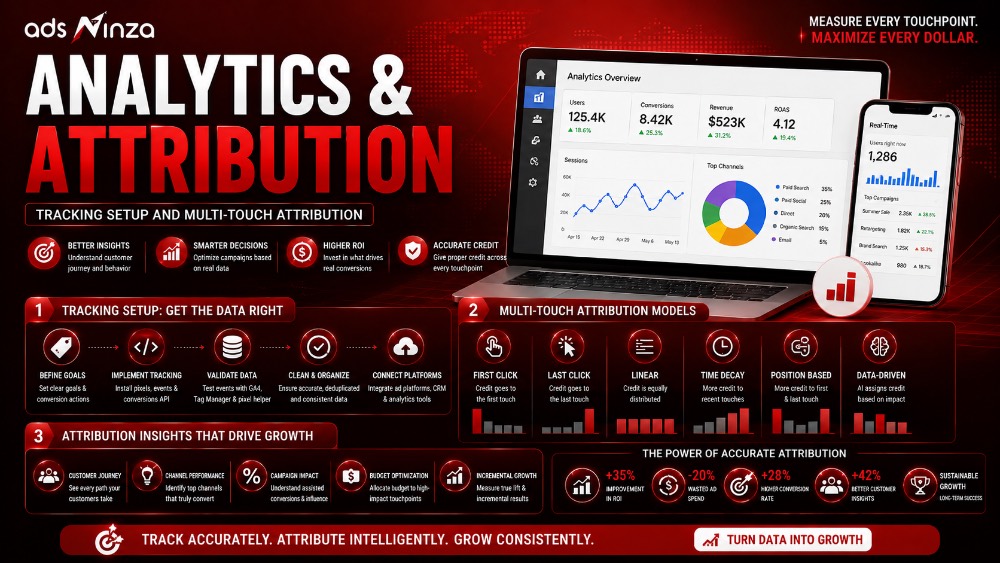
1. Define the events first, on paper. Name every event, the parameters it carries and the single moment it fires. Most tracking chaos is a naming problem that hardened into a system.
2. GA4 and Google Tag Manager as the base layer. One clean data layer, consistent event names, deduplicated triggers, internal traffic excluded, and cross-domain measurement set up if checkout or booking sits on another domain.
3. Server-side container. A tagging server on your own subdomain, receiving the events and distributing them to Google Ads, GA4 and Meta with a shared event ID so browser and server events deduplicate correctly.
4. Meta Conversion API with proper match parameters. Hashed email and phone, external ID, click ID, plus the event ID for deduplication. Then watch match quality until it stabilises.
5. Google Ads enhanced conversions and offline import. Send hashed first-party data with the conversion, and import CRM outcomes — qualified, proposal, won, and deal value — against the original click. This is the step that makes bidding optimise for revenue instead of form fills.
6. Consent and documentation. Consent mode where your markets require it, a written record of what is collected and why, and a privacy policy that matches the implementation. Clients in the UK and EU need this to be right, not approximate.
7. Validate, then leave it alone for two weeks. Test every event end to end, compare against CRM and order records for a fortnight, and only then change bidding. Changing measurement and strategy in the same week means you will never know which one moved the number.
What it is worth
Tracking work is unglamorous and it is the highest-return thing in most accounts, because it multiplies everything downstream. Recovered attribution stops you switching off profitable campaigns. Cleaner signal lowers acquisition cost without touching a bid. Quality feedback shifts spend toward the leads that actually close.
It is also the reason we insist on doing it before scaling media spend. Doubling budget on a broken measurement setup does not double growth. It doubles the confidence with which you make the wrong decision.
Frequently asked questions
What is the difference between client-side and server-side tracking?
Client-side tracking fires from the visitor's browser and can be blocked, delayed or cut short by privacy settings, extensions and slow connections. Server-side tracking sends the event from your own server or tagging server directly to the platform API, which is more reliable and gives you control over exactly what data is shared.
Do I need Conversion API if I already have the Meta Pixel?
Yes, and they work together. The pixel captures browser events, Conversion API captures them server-side, and a shared event ID lets Meta deduplicate. Running both recovers conversions the browser alone would lose, which is why reported performance usually improves after implementation without any change in spend.
Will server-side tracking increase my conversions?
It increases reported and attributed conversions, because events that were previously lost now arrive. It does not create sales that did not happen. The real gain is downstream: better data means the bidding algorithms make better decisions, so acquisition cost typically improves over the following weeks.
How long does a proper tracking implementation take?
For a standard Shopify or WordPress stack, one to two weeks including validation. Custom applications, multi-domain checkouts, subscription billing or CRM integrations take longer. We always allow two weeks of parallel validation against CRM or order data before letting anyone change bidding.
What is event match quality and what score should I aim for?
It reflects how many usable identifiers — hashed email, phone, external ID, click ID — accompany each event so the platform can attribute it. Higher is better; poor scores usually mean identifiers are missing or hashed incorrectly. Improving match quality is one of the cheapest performance gains available.
Is server-side tracking legal under GDPR and Indian data rules?
It can be, and it is often easier to govern than browser tracking because you control what leaves your systems. You still need a lawful basis, consent where required, honest disclosure in your privacy policy, and proper handling of personal data. Implement consent mode for UK and EU traffic and document the data flow. This is not legal advice — have counsel review your setup.
What is offline conversion import and who needs it?
It sends CRM outcomes back to the ad platform against the original click, so bidding learns which enquiries became revenue. Any business with a sales cycle longer than a checkout — B2B, real estate, healthcare, education, high-ticket services — needs it. Without it you are optimising for form fills, and form fills are easy to buy cheaply and badly.
Does server-side tagging slow down my website?
No. Moving tags off the browser generally reduces the number of third-party scripts loading on the page, which usually improves load time and Core Web Vitals. The processing happens on the tagging server instead of the visitor's device.
We use Shopify. Is tracking already handled?
Partly. Shopify's native integrations cover the basics but commonly leave gaps in server-side purchase events, value accuracy with discounts, checkout extensibility events and cross-domain handoff. We audit rather than assume, because the gaps are invisible until you compare platform reports with your order data.
Can you fix our tracking without rebuilding our website?
In almost all cases, yes. Tracking work sits alongside your site through tag management, a tagging server and API integrations. A rebuild only becomes relevant when the site itself blocks correct measurement, and we would tell you that in the audit rather than after signing.