
Your Meta Cost Per Lead Went Up. The Targeting Did Not Change. The Creative Should
Accounts still built around detailed interest targeting are paying more each month. The advertisers doing well changed where they put their effort.
By Ads Ninza · Published 5 September 2026 · 6 min read
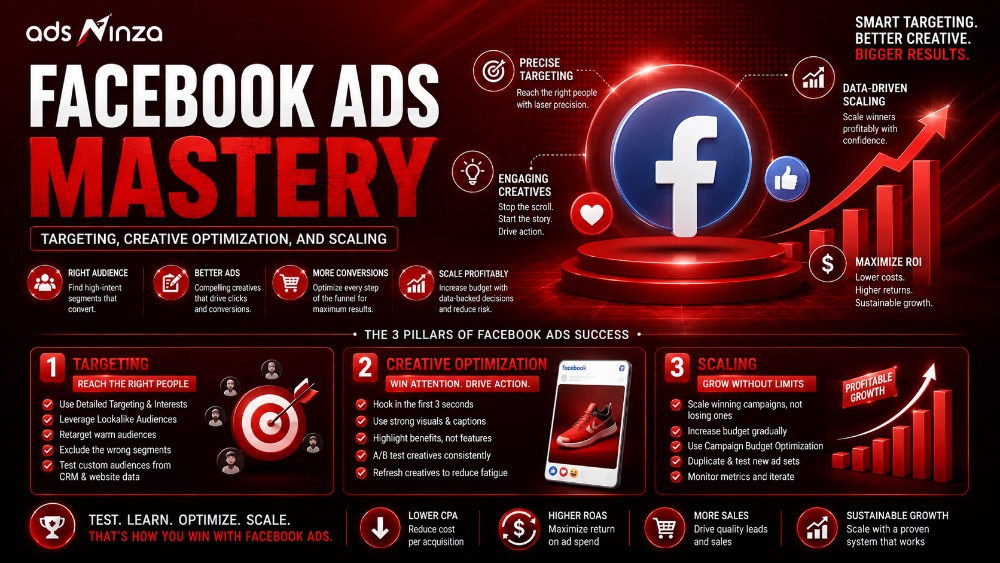
What changed in how Meta delivers ads
Meta rebuilt its ad retrieval system, the part that decides which ads are even considered for each person, around a newer model it calls Andromeda. The practical effect for advertisers is that the ad itself now does most of the targeting.
Meta reads your image or video, your copy and your offer, and uses them to predict who will respond. Broad audiences with strong creative often outperform carefully stacked interest audiences, because the system has more room to find the right people and better information about who they are.
Accounts still built the old way, with many small ad sets, narrow interests and one or two ads each, tend to see costs creep up. Each ad set has too little data, the same few creatives fatigue quickly, and the system has nothing new to work with.
Why creative variety matters more than volume
Because creative now drives delivery, different creative reaches different people. A video of a founder explaining the process reaches one group. A before-and-after image reaches another. A customer testimonial reaches a third. Each opens a new pocket of the audience.
The trap is producing many variations that the system treats as the same thing. Changing the headline colour or swapping one stock image for another does not give Meta a new signal. Genuinely different concepts do: different angles, different formats, different people on camera, different problems addressed.
In practice we aim for several new concepts entering an account each week, with the losers switched off quickly. The exact number depends on budget. The principle is that the creative pipeline, not the audience settings, is where the work now sits.
Fixing lead quality without killing volume
When cost per lead falls and sales complain about quality, the usual cause is not targeting. It is one of three things.
The form is too easy. Instant forms with pre-filled details and no questions produce accidental and low-intent submissions. Switching to a higher-intent form type, adding one or two qualifying questions and a review step removes most of the noise at a modest cost in volume.
The signal is wrong. If Meta only sees "lead submitted", it will find more people who submit. Sending lead outcomes back through the Conversions API, such as qualified, visited, purchased, lets it find people who become customers. This is the single biggest lever on lead quality.
The ad promises the wrong thing. Ads that lead with "free" or a heavy discount attract people who want free things. Ads that state the price range, who it is for and what happens next attract fewer, better leads.
We covered the economics side in our article on Meta ROAS for D2C brands and the signal side on the Conversion API page.
Account structure that suits the current system
Fewer ad sets, more ads in each. Consolidate so each ad set gets enough conversions per week to stabilise. Many small ad sets split the data and keep everything in learning.
Broad or lightly guided audiences. Use location, age where relevant and exclusions for existing customers. Let the creative do the rest. Advantage+ audience settings are usually worth testing against whatever you run now.
A steady creative rhythm. New concepts on a schedule, not in a panic when costs rise. Keep the winners running and rotate the rest out.
Budget changes in steps. Raise spend on a working ad set by modest increments every few days. Large jumps reset learning and make costs spike.
What this looks like in different markets
The mechanics are global, but creative has to fit the audience. In India, vernacular creative in Hindi, Bengali, Tamil or other regional languages often opens audiences that English ads never reach, especially outside the largest metros. Pricing shown in rupees with EMI options changes response noticeably in considered purchases.
In the UAE, running Arabic and English creative side by side reaches genuinely different audiences, and WhatsApp as the next step usually outperforms a web form. In the USA and Canada, user-generated and testimonial content tends to outperform polished brand video for lead generation. In the UK, understated creative with a clear price or process usually beats heavy claims, and advertising standards rules on claims apply.
Frequently asked questions
Why is my Meta Ads cost per lead increasing?
The most common causes now are creative fatigue, an account split into too many small ad sets, and an old structure built on narrow interest targeting. Meta delivery relies more on the creative itself to find people, so accounts without a steady supply of new creative concepts tend to see costs rise.
What is Meta Andromeda?
It is the name Meta gave to its rebuilt ad retrieval system, which decides which ads are considered for each person. It relies heavily on the content of the ad to predict who will respond, which is why creative variety has become the main lever advertisers control.
Does detailed targeting still work on Facebook and Instagram?
It still works in some cases, but less reliably than before. Broad audiences with strong, varied creative often perform as well or better, because the system has more room to find responders. Test broad against your current setup rather than assuming either wins.
How many ads should I run on Meta?
Enough genuinely different concepts that the system has new material each week. The right number depends on budget. What matters more than the count is variety: different angles, formats and messages rather than small edits of one ad.
How do I improve lead quality from Facebook lead ads?
Use a higher-intent form type, add one or two qualifying questions, state price and who the offer is for in the ad, and send lead outcomes back to Meta through the Conversions API so it learns which leads became customers.
Should I use instant forms or send people to a website?
Instant forms give more volume and lower cost per lead, and usually lower quality. Website forms give fewer, better leads. Many businesses do well with a higher-intent instant form with qualifying questions. For expensive services, a landing page or WhatsApp conversation often produces better customers.
How often should I change my Meta ad creative?
Add new concepts on a regular schedule, often weekly for accounts with meaningful spend, and switch off ads that clearly lose. Waiting until performance collapses before refreshing creative means you are always reacting late.
What is Advantage+ and should I use it?
Advantage+ is the set of Meta automation features for audiences, placements, creative and full campaigns. Used with good creative and accurate conversion data it often performs well. Used with poor signals it automates the wrong goal. Test it against your current setup.
Why do my Meta leads not answer the phone?
Usually because the form was too easy, the ad promised something free, or the follow-up was too slow. Leads from social ads cool quickly. Contacting them within minutes, ideally on WhatsApp in India and the UAE, makes a large difference to contact rate.
How do we start with Ads Ninza?
Apply through the form on this page. On a paid discovery call, INR 499 in India and $9 elsewhere, we review your Meta account structure, creative and lead quality with you. Meta Ads management starts at INR 35,000 per month in India and $500 per month outside India.