
Meta Ads ROAS for Indian D2C Brands: The Economics Nobody Shows You
Reported ROAS is not profit. Here is the number Indian D2C brands should be scaling on, and why creative volume beats audience targeting every time.
By Ads Ninza · Published 28 July 2026 · Updated 16 August 2026 · 10 min read
The ROAS on your dashboard is not the ROAS in your bank account
Ask ten Indian D2C founders what their ROAS is and ten will read a number off Ads Manager. Ask what their contribution margin is after cost of goods, shipping, payment gateway charges, returns and refused deliveries, and the room goes quiet.
That gap is where brands die while celebrating. A 3x reported ROAS on a product with a 45 per cent gross margin, 12 per cent return-to-origin on cash-on-delivery orders and free shipping is not a profitable brand. It is a subsidy programme.
Before we touch any account, we build a single sheet: selling price, product cost, packaging, shipping in and out, RTO rate split by prepaid and COD, payment charges, discount rate, and repeat purchase within 90 days. Out of it comes one figure — the break-even ROAS. Every scaling decision after that is measured against it, not against a number borrowed from someone's LinkedIn post.
Creative is the targeting layer now
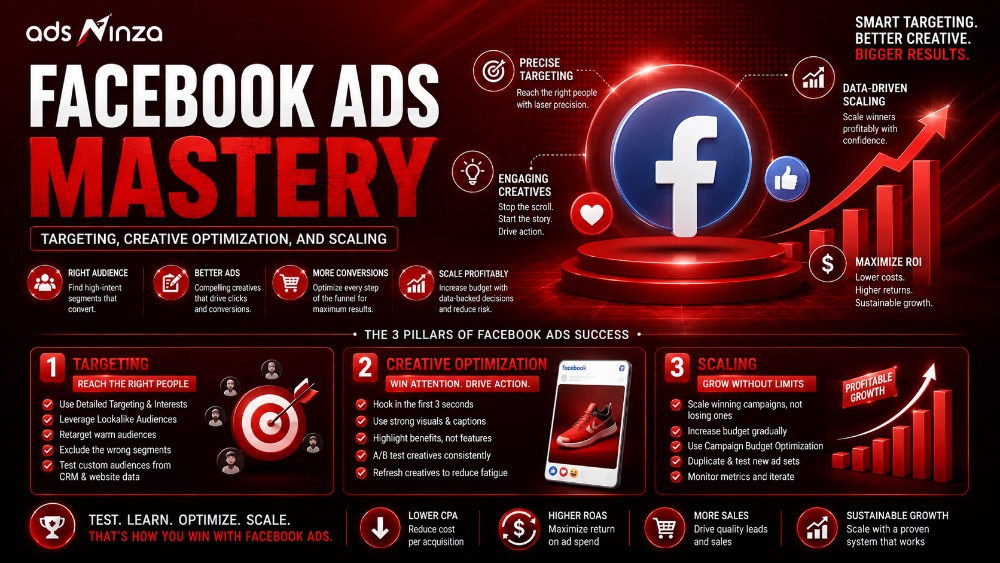
Detailed interest targeting used to be where advertisers earned their fee. It is not any more. Broad audiences with strong conversion signal outperform hand-stacked interests in most Indian accounts we take over, and the reason is simple: Meta's delivery system has more behavioural data about the buyer than any interest list you can assemble.
What you control is the input. Every creative is a hypothesis about why someone buys, and each one lets the algorithm find a different pocket of demand. A brand testing four videos a month is exploring four pockets. A brand testing twenty is exploring twenty, and it will find the cheap ones first.
How we structure testing:
- Angles before executions. Write the five reasons a customer actually buys — price versus a known alternative, a specific problem solved, social proof, fear of a bad purchase, convenience. Each becomes a creative family.
- Formats that suit the angle. Founder-to-camera for trust, UGC for proof, static comparison for price, unboxing for gifting, before-and-after for a visible result.
- One variable at a time in the first three seconds. Hook, opening frame and on-screen text carry most of the performance difference. Change one, keep the rest.
- Kill on cost per purchase, not on video views. Engagement rate has never paid an invoice.
- Language matters. Hindi and Hinglish hooks routinely outperform English in Delhi, Lucknow, Ghaziabad and Nagpur, while English holds up in Bengaluru, Mumbai and Pune. Tamil, Bengali and Telugu creative are underused advantages in Chennai, Kolkata and Hyderabad.
The tracking problem is an economics problem
Meta can only optimise toward events it receives. Browser-only pixel tracking in an environment of ad blockers, iOS privacy limits and slow mobile connections loses a meaningful share of conversions. The brand then sees a falling ROAS and cuts spend, when the sale actually happened and simply was not reported.
The fix is Conversion API — server-side events sent from your store or server with proper deduplication and match quality, so purchases are attributed even when the browser event is lost. On Shopify it is a configuration and validation job; on custom stacks it needs implementation. Either way it belongs in place before any scaling decision, because otherwise you are steering on a broken instrument.
Two additions we always make for Indian brands: send order-level value including discounts rather than a fixed price, and where COD is a large share of orders, send the confirmed-delivery event as well. Once the account learns from delivered revenue instead of placed orders, RTO stops being an invisible tax.
Scaling without collapsing ROAS
Most ROAS collapses we are called in to fix were caused by the scaling method, not by the market.
What works: raise budget on the ad set that is winning, in steps of roughly 20 to 30 per cent, no more than every couple of days, so the learning phase is not reset. Duplicate a proven winner into a new campaign only when you are deliberately testing a different audience or objective. Keep a consolidated campaign structure so the conversion signal is not split across twelve ad sets that each have too little data to learn from.
What does not work: doubling budget overnight, launching fifteen new ad sets in a week, switching optimisation events mid-flight, and turning creative off after one poor day. Every one of those resets learning, and learning is the asset you are actually paying to build.
Add one more thing to the plan: retention. A brand with 25 per cent repeat purchase inside 90 days can afford a first-order ROAS that would bankrupt a brand with none. Email, WhatsApp and a genuine reason to reorder are cheaper growth than any bid change.
Frequently asked questions
What is a good ROAS for D2C brands in India?
The only ROAS that matters is your break-even ROAS plus the margin you need. Calculate it from selling price, cost of goods, shipping, payment fees, discounting and your return-to-origin rate. A 2x can be highly profitable for a high-margin product with strong repeat purchase, and a 4x can lose money on a low-margin product with heavy COD returns.
Why did my Meta Ads ROAS drop after I increased budget?
Usually because the increase reset the learning phase, split the conversion signal across too many ad sets, or pushed delivery past the cheap pocket of demand the winning creative had found. Raise budget in increments of 20 to 30 per cent every two to three days on the ad set that is performing, keep structure consolidated, and make sure new creative is entering the account continuously so delivery has somewhere fresh to go.
How many creatives should I test each month?
For a brand spending seriously, plan on 15 to 25 new assets a month built from four or five distinct buying angles rather than twenty variations of one idea. Creative volume, not audience tinkering, is what keeps cost per purchase down as you scale.
Do interest-based audiences still work on Meta in India?
They still have a place for very specific niches and for early signal when an account has no conversion history, but broad targeting with strong creative and clean conversion data outperforms stacked interests in most accounts we audit. Spend your effort on creative and on the quality of the events you send back.
What is Conversion API and do I really need it?
It sends purchase and lead events from your server to Meta instead of relying only on the browser pixel, so conversions still get attributed when a browser event is blocked or lost. Without it, reported performance understates reality and the algorithm optimises on partial data. For any brand spending meaningfully, it is not optional.
How do I handle COD returns in my ad account?
Send the delivered-order event, with its real value, back to Meta alongside the purchase event, and optimise against it once volume allows. Also test prepaid incentives, address confirmation on WhatsApp, and excluding audiences with repeated refusals. RTO is an advertising problem as much as a logistics one, because it decides which orders the algorithm learns to chase.
Should I run Meta and Google Ads together?
For most D2C brands, yes. Meta creates demand and Google captures it — brand search volume usually rises with Meta spend, and if you are not bidding on your own brand terms someone else will collect that traffic. The two need to be planned together, with one view of blended acquisition cost, rather than judged as separate scoreboards.
How long does it take to see results from a new Meta Ads account?
Expect two to three weeks to establish tracking and initial creative signal, and six to twelve weeks for stable, scalable performance. The variables are your budget, how quickly creative can be produced, and how much conversion volume the account generates for learning.
Do you produce the creative or do we?
Both models work. We build the angle and script framework and can produce statics and edits; brands with an in-house creator or a UGC pipeline usually get further faster because volume is cheaper for them. What we insist on is the testing discipline and that judgement comes from cost per purchase, not from opinions in a review meeting.
My product sells well in Mumbai and Bengaluru but not elsewhere. What should I do?
Treat that as information, not a problem. Look at whether price sensitivity, COD share, language or delivery times differ in the weaker markets, then test market-specific creative and offers before spending more there. Sometimes the right answer is to concentrate budget where the economics work and enter other cities with a different offer entirely.